Consulting
Sales funnel: real rates by stage and how to find where the sale drops
 By JCUpdated 8 min read

A sales funnel is the visual and metric process a potential customer follows from the first contact to the closing of a transaction. It allows you to identify exactly where in the commercial process prospects are being lost so you can optimize conversion at every intermediate step. It is the primary tool to stop guessing why you aren't hitting your monthly revenue goals.
What is a sales funnel?
It is a model that represents the stages of your prospects' buying journey. At the top, a large volume of interested people enters. As they move toward their decision, the group gets smaller until only the final buyers remain.
In the projects I lead, the first thing I check is if the client understands their funnel as a living flow. It is not a static drawing for a PowerPoint presentation. It is a series of filters where every percentage drop tells a story about your business.
If you measure these steps correctly, you stop blaming luck for low sales. A well-structured funnel tells you if the problem is a lack of prospects or your response capacity. I work with HubSpot and ActiveCampaign every day and I see that funnel clarity separates companies that scale from those that just spend money.
What are the stages of a sales funnel?
Stages vary by industry, but most B2B or high-ticket service businesses follow a similar route. Everything starts with brand awareness and ends with money in the bank.
The first stage is attraction, where people reach your site or social media. Then they become leads when they leave contact information. At this point, marketing must filter those who can actually buy to pass them to the sales team.
The opportunity stage is when a quote or a clear intent to buy already exists. Closing is the final step where the contract is signed or payment is received. Defining what "qualified" means for your company is the step that saves your salespeople the most time.
| Funnel Stage | Stage Definition | Main Owner |
|---|---|---|
| Lead (MQL) | Prospect who left data and meets basic marketing criteria. | Marketing |
| Lead (SQL) | Prospect the sales team accepted to begin management. | Sales |
| Opportunity | Potential client with an economic proposal on the table. | Sales |
| Closing | Completed transaction and confirmed payment. | Sales / Finance |
What percentage of leads converts at each stage?
This is the question almost no one knows how to answer with data in hand. Conversion rates change drastically from one industry to another. You cannot compare a clothing store with apartment sales or enterprise software.
According to data from the agency First Page Sage published on August 10, 2026, rates vary by business model. In the real estate sector, the move from lead to marketing qualified is 27%. For B2B SaaS companies, that same stage usually converts 39% of initial contacts. These figures come from their own clients and their methodology is not audited.
Below, I detail the rates by stage for these two sectors. They are averages and serve as a reference to evaluate your current performance.
- Real Estate: Lead to MQL (27%), MQL to SQL (33%), SQL to Opportunity (40%), Opportunity to Closing (53%).
- B2B SaaS: Lead to MQL (39%), MQL to SQL (38%), SQL to Opportunity (42%), Opportunity to Closing (37%).
How many leads do I need to reach my sales goal?
To know how many leads you need, you must do the calculation in reverse. You start with your sales goal and apply the conversion percentages from the bottom up. This gives you the real number of people who must enter the top of your funnel.
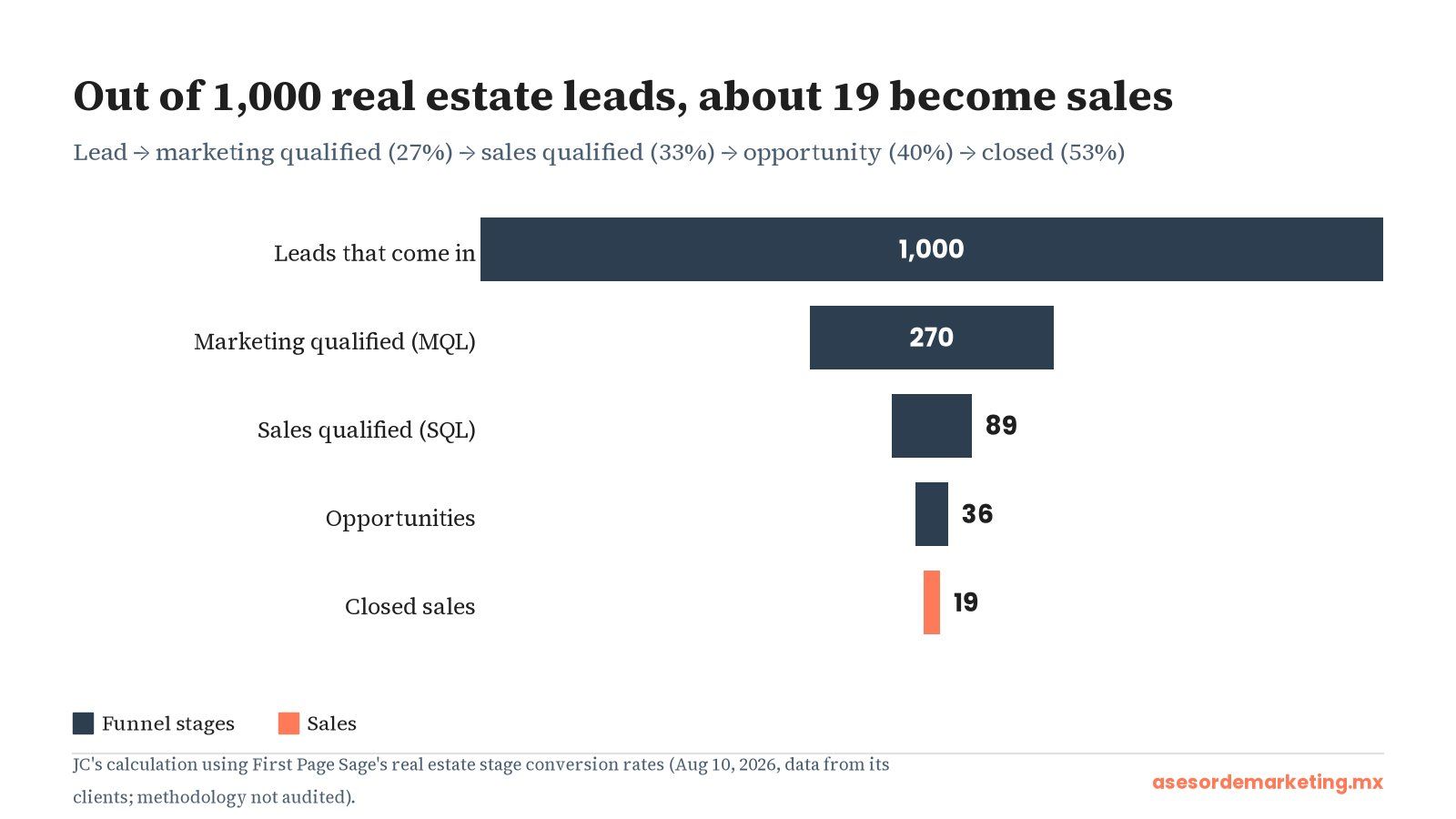 JC's calculation using conversion rates by stage for real estate from First Page Sage (Aug 10, 2026, data from their clients; non-audited methodology).
If we apply these rates, we see clear differences in demand generation effort. In real estate, you need to attract more people to achieve one sale due to the initial filters. In enterprise software, the funnel is usually wider in the early stages but harder to close at the end.
| Concept | Real Estate (10 sales) | B2B SaaS (10 sales) |
|---|---|---|
| Monthly sales goal | 10 closings | 10 closings |
| Estimated total conversion rate | 1.89% | 2.30% |
| Total leads needed | ~530 leads | ~435 leads |
| Qualified leads needed (MQL) | 143 prospects | 170 prospects |
| Opportunities needed | 19 proposals | 27 proposals |
Where does the sale drop most frequently?
In my experience, the biggest money leak occurs between lead registration and the first human contact. Many business owners think their leads are bad. However, the problem is usually the sales team's response speed.
An InsideSales study of 5.7 million leads showed that only 0.1% of contacts are handled in less than 5 minutes. If you take longer than that, the probability of conversion drops 8 times. Even worse, 57.1% of first call attempts happen after a week of waiting.
Furthermore, contacting a prospect within the first hour gives you nearly 7 times more probability of qualifying them. It doesn't matter how good your ad is if your salesperson answers three days later. The customer has already looked for your competition and likely already booked with them.
| Observed Symptom | Stage where the sale drops | What to check in your process |
|---|---|---|
| Many leads but no one answers the phone. | Lead to Contact | Response speed and assignment process. |
| Prospects say "it's not what they were looking for." | Marketing to Sales | Ad messaging and form filters. |
| Many quotes sent but no one signs. | Opportunity to Closing | Follow-up quality and objection handling. |
| Site traffic is high but there are no registrations. | Visit to Lead | Offer clarity and ease of contact. |
How is a sales funnel measured in a CRM?
Measuring the funnel requires marketing and sales to speak the same language. According to HubSpot's State of Marketing 2026 report, more than 27% of marketers say aligning both areas is one of their biggest challenges. Without this alignment, CRM data does not reflect reality.
To measure correctly, every stage in your CRM must have a clear action that triggers it. For example, an "Opportunity" only exists when the client has accepted a date for a demo or received a budget. If you allow salespeople to move prospects based on intuition, your metrics won't work for decision-making.
Another factor changing measurement is today's buyer behavior. Gartner indicates that 67% of B2B buyers prefer a rep-free buying experience. Additionally, 45% have already used artificial intelligence in a recent purchase. Your funnel must include self-service channels to avoid losing these users.
To go deeper into how to set up these tools, you can see the criteria I recommend for a real estate CRM. It is also fundamental that you learn to measure sales and not just clicks to understand your return on investment.
Steps to audit your funnel today
The first thing I do in consultations is review the history of the last three months. If you don't have data, start capturing it today in a simple table. You need to know how many leads entered and how many moved to each subsequent stage.
Review the marketing KPIs that actually impact the business. Don't look at "likes" or reach. Focus on the cost per qualified lead and the time a prospect spends in each stage. In my experience, an opportunity that has gone weeks without movement is almost always already lost.
The role of technology in conversion
Having expensive software is not enough. Technology should serve to eliminate friction in the funnel. If you use very long forms, your visit-to-lead conversion rate will drop. If you don't have automatic alerts for your salespeople, your response speed will be slow.
Use automation for repetitive tasks. You can send an immediate welcome email while the salesperson prepares to call. This keeps the customer's interest active. If you want a more detailed analysis of your current situation, I suggest taking my commercial diagnostic. Organizing the funnel with data is exactly what I do in marketing consulting and fractional CMO services.
FAQ
What is the difference between a marketing funnel and a sales funnel?
The marketing funnel focuses on attracting people and converting them into interested prospects. The sales funnel takes those prospects and guides them through negotiation until final payment. Both must function as a single unified system to be effective.
What is a good lead-to-sale conversion rate?
It depends heavily on your industry and the price of what you sell. Using First Page Sage rates, lead-to-sale ends up at 1.89% in real estate and 2.30% in B2B SaaS. Use them as a comparison point, not a goal: what matters is that your own rate goes up month after month.
Why does my funnel have many leads but few sales?
The most likely reason is that the initial filter is too low or follow-up is poor. Check if your salespeople are contacting people in less than an hour. Also verify if the ad promises something your sales team cannot deliver when speaking with the client.
How can I improve my sales funnel quickly?
Focus on the stage that currently has the sharpest percentage drop. If you have leads but aren't closing, improve your follow-up process and sales scripts. If you don't have leads, review your paid media strategy and the clarity of your value proposition on the site.
If you want to know which stage is losing you sales, book 30 minutes and let's review your numbers.